
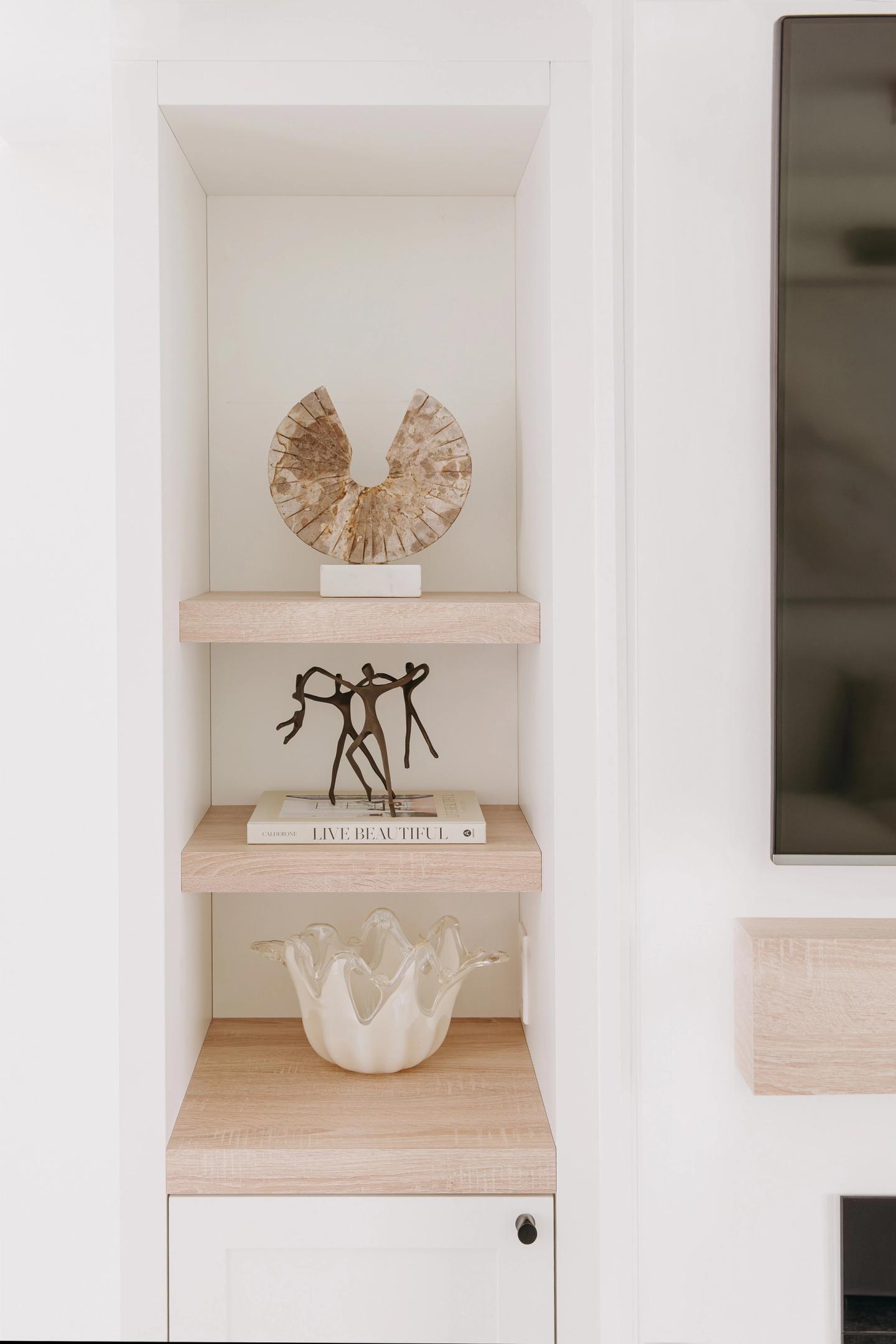
What it means in a house
Wabi-sabi is an appreciation of age, asymmetry, and the way natural materials behave over time. In a house it means natural materials allowed to move, mark and darken, sitting inside work that was executed precisely. It is not distressed furniture. It is not sanding the edge of a new dresser so it looks old. And it is never a reason to accept sloppy work.
The misreading is understandable. Wabi-sabi photographs as rough, so people assume rough is cheap. A hand-troweled lime finish runs roughly 40 to 60 per cent more in labour than the same wall rolled flat, because every square foot passes under a trowel held by a person with an opinion.
Somebody chose that irregularity. Somebody drew it, priced it, and stood there while it went on wet. Random and intentional look nothing alike across a room.
Why it costs more, not less
A controlled irregular finish takes more skill and more time than a flat one, and there is nowhere to hide. Flat drywall and paint forgive a mediocre installer. Plaster, solid timber and natural stone do not.
Three things drive the cost.
- Labour hours. Troweled finishes go on in multiple passes, wet, by hand, in a working window that closes fast.
- Skill. The trades who can do this well are booked, and they price accordingly.
- Selection. Nothing natural repeats. Quartz is engineered, so a plain pattern can be ordered from a sample, and even a veined one varies less than stone. Marble matches nothing but itself, which means somebody drives to the yard, walks the racks, and picks the piece going into your kitchen. Then the fabricator lays out the veining so it runs continuously across the seam. That is a day of work that never shows up in a photograph, and it is worth paying for.
Patina and damage are not the same thing
Patina is a material changing in a way that is native to it. Damage is a failure, the material asked to do a job it cannot. Brass darkening is patina. Marble etching under a lemon is patina if you agreed to it going in, and damage if nobody told you. A cracked mitre on a cabinet door is damage.
Patina looks like this: unlacquered brass moving from bright to bronze, deeper in the corners and brighter where hands land. Limewash softening and mottling as it cures. A white oak floor going amber over a few years of sun. Soapstone darkening where oil touches it.
Damage is water where water should not be, joinery opening up, a finish peeling off its substrate, a stone chipped at an unsupported edge, or a wall repair that reads as a repair.
Materials that age well
Unlacquered brass, lime plaster and limewash, solid timber, natural stone, and oiled wood floors. Every one of them changes, and the change is what you are paying for.
Unlacquered brass goes from bright to a soft bronze in six to twelve months in a working kitchen, faster around a sink. Lacquered brass stays bright for about two years, then the lacquer wears through in patches at the handles. Patchy is the ugly outcome, not dark. Pick unlacquered and let it go.
Lime plaster and limewash are mineral. They breathe, they hold light differently at different times of day, and they look better as they cure rather than worse. Paint looks its best the day it dries.
Solid timber moves with humidity. A 30-inch-wide solid oak counter can shift about a quarter inch across its width between a Markham August and a February with the furnace running. That is not a defect. It is why the fastening detail uses slotted hardware instead of a screw straight through.
Marble etches with acid, whatever the sealer says. If a dull ring where somebody set a glass of wine is going to bother you every day for ten years, we will put quartz in your kitchen and marble somewhere it is admired more than it is used. The Calacatta arch at Sandcherry is marble in that role, a surface for looking at. Honed hides more than polished.
A hand-troweled wall needs a better plasterer, not a worse one
On a flat wall the standard is objective. Flat can be checked with a work light and a straight edge, and anyone can see the failure. A troweled finish has no straight edge to check against, so its whole quality lives in the rhythm and pressure of whoever applied it, and it cannot be corrected afterward with sandpaper.
Consistent variation reads as a material. Inconsistent variation reads as a mistake, and the difference between them is the plasterer.
So we mock up. A sample board of at least four feet by four feet, on site, in that room's real light, viewed at the time of day you use the room. Never approve a plaster finish from a six-inch chip in a showroom under halogen.
Let the brass go dark
That is why you specified it. Stop polishing the faucet, and stop sealing the soapstone every month. The house is supposed to record that people live in it, and a surface that shows nothing after five years is telling you it is plastic.
What you do protect is the work underneath. Tight joinery, correct substrates, proper waterproofing, level where level matters.
If you are planning a renovation and want the finishes to earn their age, send us the room and tell us the light it gets. We will tell you which materials belong in it. Start a conversation.