
What is the real difference between porcelain, quartz and marble?
Marble is quarried stone. It is soft, porous, and it reacts chemically to acid. Engineered quartz is ground quartz bound in resin, so it is non-porous and visually consistent, but the resin does not like heat. Porcelain is a slab fired at very high temperature, which makes it hard, heat resistant and stable under UV, and it is the one material where the fabricator matters more than the slab.
Marble sits around 3 on the Mohs hardness scale. Quartz and porcelain both sit near 7. That one gap explains most of what follows.
Slabs commonly arrive at about 3.2 metres by 1.6 metres, so an island longer than that usually has a seam whatever the material, and the conversation is where it goes.
Will marble really etch and stain in a working kitchen?
Yes. A lemon wedge left on polished marble leaves a dull mark within minutes. That is etching, a chemical reaction between acid and calcium carbonate, and sealer does not prevent it. Sealer slows staining. Nothing stops etching except keeping acid off the stone.
Red wine, vinegar, tomato, citrus, some cleaners. All of it leaves a mark.
Honed marble hides etching far better than polished, because the surface is already low sheen and the etch has less to contrast against. A polished Calacatta island in a busy kitchen will show its history within a year. Some of our clients love that. They call it patina and they mean it.
Others are unhappy in week one, and we would rather find that out at the selections table than after installation.
When is marble the wrong choice?
A household with young children, a lot of citrus and red wine on a Tuesday should not put marble on the main work run. Neither should anyone who tenses up at a ring on a coffee table.
We specify marble often, and not on every work run.
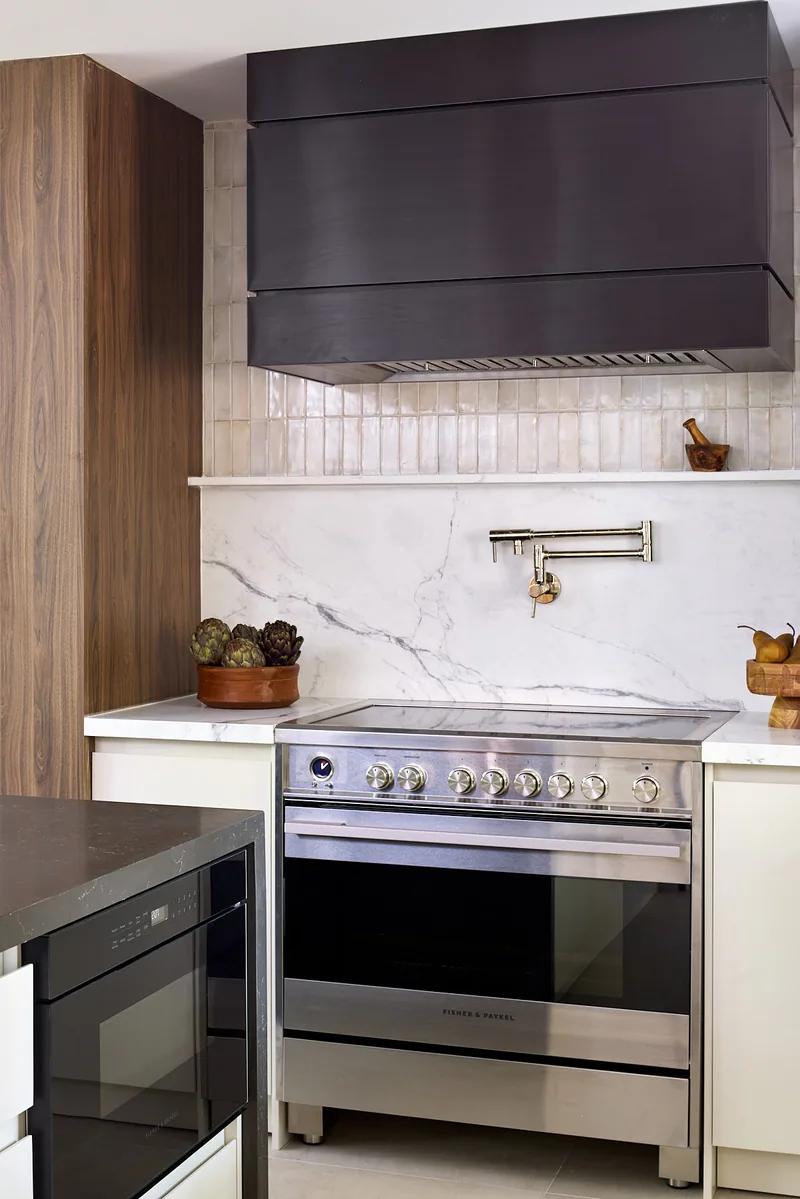
The better move is usually placement, not refusal. Marble reads beautifully on a baking counter, a coffee station, a bar back or a fireplace surround, where it gets the light and the veining does its work without absorbing every spill. Then something harder carries the sink and the prep zone. A veined porcelain will also get you close.
Is quartz maintenance free?
Close, but not immune. It never needs sealing, it does not etch from lemon, and it shrugs off the ordinary abuse of a family kitchen. The two most common ways to damage it are heat and long exposure to direct sun.
Set a pan straight off the burner on quartz and the resin binder can discolour or craze. There is usually no repair for that beyond replacing the piece.
Long UV exposure can yellow some quartz, so keep it out of a wall of unshaded south glass and off an outdoor kitchen unless the product is rated for it.
Seams read differently on quartz too. Because the pattern is manufactured and consistent, the eye expects it to continue, and a seam that does not line up looks like a mistake. In natural stone, veining absorbs the joint. On quartz, plan the seam location deliberately at the selections stage.
Is porcelain worth it, and what can go wrong?
Porcelain is the toughest of the three. Heat resistant, non-porous, UV stable, thin, and the one that works outdoors with the least argument. The risk is in the fabrication rather than the material.
Porcelain counters are commonly 12 mm thick, sometimes 6 or 20, so an edge that reads thicker than the slab is usually a mitred fold, two pieces glued at 45 degrees. A good mitre disappears completely. A bad one shows a dark seam line, a lipped edge, or a chipped corner that no amount of polish will fix.
Ask any fabricator to show you a finished mitred edge in person before you sign, and run your fingernail along it.
Two more things to check. Cutouts and drilling need proper tooling and internal radiused corners, because a square internal corner in porcelain is a crack waiting to happen. And ask whether the pattern runs through the body of the slab or sits only on the printed face. Cheaper porcelain shows a pale core at every exposed edge.
What is book-matching, and does veining really matter?
Book-matching is when two slabs cut sequentially from the same block are opened like a book, so the veining mirrors across the joint. It is the difference between a waterfall island that looks quarried and one that looks assembled.
It matters most on a waterfall return, a full-height backsplash and a fireplace. It matters less on a straight run against a wall.
Vein direction is a design decision, not a fabrication accident. Veining that runs the length of an island stretches the room. Veining that runs across it chops the island into segments. Decide that before the fabricator builds the cutting layout, because after the first cut there is no second opinion.
How do I make sure I get the slab I approved?
Go to the yard, pick the exact slabs, photograph them with the tag and bundle numbers visible, and have those numbers written into the purchase order. Then review the fabricator's digital layout, which shows exactly where every piece falls on your slabs, before anything is cut.
Names are not guarantees. Two bundles of the same marble from the same supplier, quarried from different blocks, can look like different stones. Approving a 100 mm sample chip and hoping is how people end up disappointed on install day.
For anything with strong veining, we also dry-lay the pieces at the shop and walk the client through it. Twenty minutes there saves a very bad morning later.
So which one should I choose?
For most working family kitchens, put porcelain or quartz on the run that does the work, and give marble the surface that gets admired more than it gets used. If you want one material everywhere and you cook seriously, choose porcelain and spend the savings on the fabricator, not the slab.
Bring your plan and a shortlist of two materials, and come to the yard with us. We will pick real slabs, tag them and hold them, and because templating, book-matching and fabrication all run under One millwork, the slab you approve is the slab that arrives. Start a conversation.